How Ferrari Was Created: History, Models & Legendary Supercars
Discover how Ferrari was created, from Enzo Ferrari and the 125 S to the 250 GTO, F40, F50, Enzo, LaFerrari, SF90, 296 GTB and Purosangue.

Ferrari is much more than a car manufacturer. Born from motorsport, the Italian brand has become a global symbol of performance, racing heritage, engineering, exclusive design and high-performance V8 and V12 engines.
The story of Ferrari is inseparable from its founder, Enzo Ferrari. His passion for motor racing evolved from a career as a racing driver into the creation of a racing team and, eventually, one of the most famous sports car manufacturers in automotive history.
In this comprehensive AutoCarso guide, we explore how Ferrari was created and examine important models including the 125 S, 166 Inter, 250 GTO, Dino 246, Testarossa, F40, F50, Enzo, 458 Italia, LaFerrari, 488 GTB, Roma, SF90 Stradale, 296 GTB and Purosangue.
Who Was Enzo Ferrari?
Enzo Anselmo Giuseppe Maria Ferrari was born in Modena, Italy, on February 18, 1898. From an early age, he developed a strong interest in automobiles and motor racing.
Enzo Ferrari eventually became a racing driver and competed for Alfa Romeo. Over time, however, his interests increasingly moved toward team management, engineering and the development of competitive racing cars.
His ambition was not simply to manufacture automobiles. Competition was at the heart of his philosophy, and racing would ultimately become a fundamental part of Ferrari's identity.
How Was Scuderia Ferrari Founded?
Enzo Ferrari established Scuderia Ferrari in 1929. In its early years, the team competed primarily using Alfa Romeo racing cars.
Scuderia Ferrari gradually developed into one of the most famous names in international motorsport. Experience gained on the racetrack later influenced Ferrari road cars in areas such as engines, transmissions, chassis development, aerodynamics and vehicle dynamics.
When Was Ferrari Founded as a Car Manufacturer?
Although Scuderia Ferrari dates back to 1929, the beginning of Ferrari as the manufacturer we recognize today is generally associated with 1947.
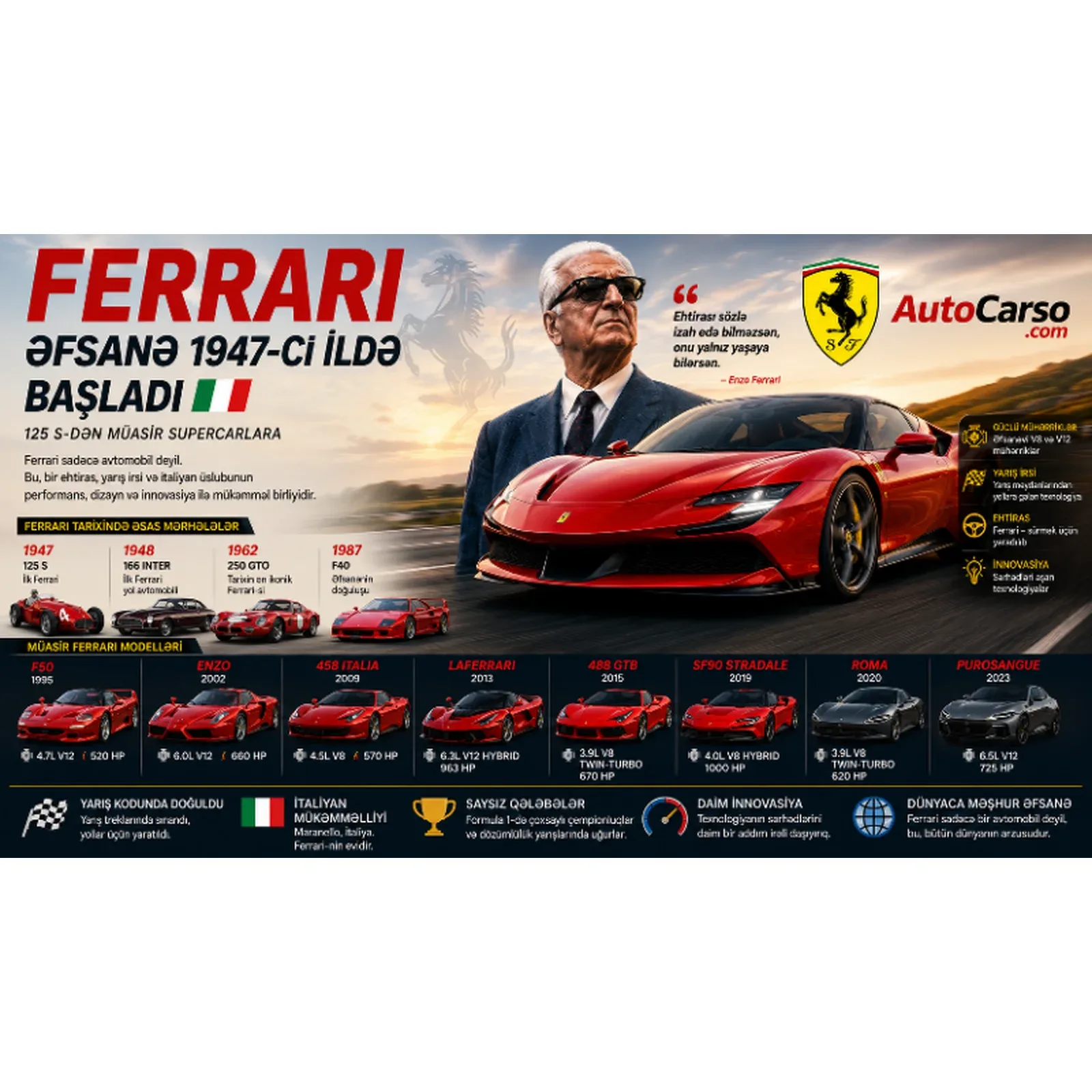
On March 12, 1947, the engine of the Ferrari 125 S was started in Maranello. The 125 S became the first automobile to carry the Ferrari name.
This moment marked the beginning of a new chapter in automotive history and established the foundations of Ferrari's long tradition of high-performance road and racing cars.
Ferrari 125 S — The First Ferrari
The Ferrari 125 S was the first car to carry the Ferrari badge. One of its most significant features was its compact V12 engine, a configuration that would become deeply connected with Ferrari throughout the company's history.
ModelFerrari 125 S Year1947 Engine1.5-liter 60° V12 Displacement1,496.77 cc Power118 hp Maximum Engine Speed6,800 rpm Transmission5-speed manual Dry WeightApproximately 650 kg Top SpeedApproximately 210 km/hThe 125 S failed to finish its first race because of a technical problem despite showing competitive performance. Soon afterward, however, Ferrari achieved its first racing victory.
The 125 S therefore became more than simply Ferrari's first car. It established the relationship between racing and road-car engineering that would define the brand for decades.
Ferrari 166 Inter — Ferrari Enters the Road-Car Market
Ferrari quickly expanded beyond pure competition cars. Introduced in 1948, the Ferrari 166 Inter became an important early road-going Ferrari and helped establish the company's Gran Turismo tradition.
Ferrari was beginning to combine racing-derived engineering with vehicles designed for high-speed long-distance road use, comfort and exclusivity.
The Ferrari 250 Family
The 1950s and 1960s produced some of the most celebrated Ferrari automobiles ever created. The Ferrari 250 family played an especially important role during this period.
Numerous racing and road-going variants were produced, including famous names such as the 250 GT, 250 GT California and the legendary 250 GTO.
Ferrari 250 GTO — An Automotive Icon
Introduced in 1962, the Ferrari 250 GTO became one of the most recognizable classic Ferraris in history.
Its body was shaped not simply for visual appeal but also to improve aerodynamic performance in competition. Its combination of racing heritage, rarity and design has helped make the 250 GTO one of the most celebrated collector cars in the world.
Dino 206 GT and 246 GT
The Dino name was connected to Enzo Ferrari's son, Alfredo "Dino" Ferrari. Dino models represented a different approach from Ferrari's traditional large-engine GT cars.
Famous Dino Models
- Dino 206 GT
- Dino 246 GT
- Dino 246 GTS
The Dino 246 in particular became an icon of compact, mid-engine Italian sports-car design.
Ferrari Berlinetta Boxer
During the 1970s, Ferrari further developed the concept of high-performance mid-engine road cars with the Berlinetta Boxer family.
Major Berlinetta Boxer Models
- Ferrari 365 GT4 BB
- Ferrari 512 BB
- Ferrari 512 BBi
These models helped establish the technical layout that would influence generations of Ferrari supercars.
Ferrari 308 GTB and 308 GTS
The Ferrari 308 family became one of the most recognizable Ferrari ranges of the 1970s and 1980s.
Its mid-engine layout, V8 engine and distinctive Italian styling helped establish a formula that would evolve through later generations of Ferrari V8 sports cars.
Ferrari Testarossa
Few automobiles represent the supercar culture of the 1980s as strongly as the Ferrari Testarossa.
Its extremely wide body, dramatic side air intakes and 12-cylinder engine made it instantly recognizable. The Testarossa combined exotic styling with Ferrari's high-performance Grand Touring philosophy.
Testarossa Family
- Ferrari Testarossa
- Ferrari 512 TR
- Ferrari F512 M
Ferrari 288 GTO
The 288 GTO occupies a special place in Ferrari history. Developed as an extreme performance machine, it combined lightweight construction with a twin-turbocharged V8 engine.
The 288 GTO also became the starting point of a special lineage of flagship Ferrari performance cars that would later include the F40, F50, Enzo and LaFerrari.
Ferrari F40 — One of Ferrari's Greatest Supercars
Ferrari introduced the F40 in 1987 to celebrate 40 years of Ferrari automobile production.
It has particular historical significance because it was the final Ferrari road car personally approved by Enzo Ferrari.
Lightweight composite construction, aggressive aerodynamics, a huge rear wing and a twin-turbocharged V8 made the F40 one of the most extreme road cars of its era.
Engine2.9L Twin-Turbo V8 PowerApproximately 478 hp DriveRear-wheel drive Transmission5-speed manual Top SpeedOver 320 km/hFerrari F50
Introduced in 1995, the Ferrari F50 attempted to bring Formula 1-inspired engineering closer to a road-going supercar.
It featured a naturally aspirated V12 engine, carbon-fiber construction and a highly focused driving experience.
Key Ferrari F50 Features
- 4.7-liter naturally aspirated V12
- Approximately 520 hp
- 6-speed manual transmission
- Carbon-fiber monocoque
- Mid-engine layout
Ferrari 360 Modena
The 360 Modena marked an important stage in the evolution of Ferrari's modern mid-engine V8 sports cars.
Extensive use of aluminum, a naturally aspirated V8 and advanced aerodynamics helped establish the foundations for the Ferrari models that followed.
Ferrari Enzo
In 2002, Ferrari introduced a flagship supercar named after company founder Enzo Ferrari.
The Ferrari Enzo incorporated Formula 1-inspired aerodynamics, carbon-fiber construction, advanced electronics and a naturally aspirated V12 engine.
Engine6.0L Naturally Aspirated V12 Displacement5,998.8 cc Power660 hp Maximum Engine Speed7,800 rpm Top SpeedOver 350 km/hFerrari F430
The F430 continued Ferrari's mid-engine V8 sports-car tradition while introducing increasingly sophisticated electronic vehicle-control systems.
One of its notable innovations was the steering-wheel-mounted Manettino switch, which allowed drivers to select different settings for the car's dynamic systems.
Ferrari 458 Italia
The Ferrari 458 Italia became one of the most famous naturally aspirated V8 Ferraris of the modern era.
Engine4.5L Naturally Aspirated V8 PowerApproximately 570 hp Transmission7-speed dual-clutch LayoutMid-engineThe 458 family also included the open-top 458 Spider and the more performance-focused 458 Speciale.
LaFerrari — Ferrari Enters the Hybrid Hypercar Era
LaFerrari was unveiled in 2013 and represented a major technological step forward for the company.
It combined a naturally aspirated V12 engine with an electric motor and hybrid technology influenced by Ferrari's experience in Formula 1.
LaFerrari Technology
- 6.3-liter naturally aspirated V12
- Electric motor
- Hybrid powertrain
- Carbon-fiber construction
- Active aerodynamics
- Formula 1-derived technology
LaFerrari continued Ferrari's special flagship lineage after the 288 GTO, F40, F50 and Enzo.
Ferrari 488 GTB
The 488 GTB represented a major change in Ferrari's mid-engine V8 range as the company adopted twin-turbocharging for a new generation of supercars.
Engine3.9L Twin-Turbo V8 PowerApproximately 670 hp Transmission7-speed dual-clutch DriveRear-wheel driveFerrari later introduced the more extreme 488 Pista, which focused on reduced weight, improved aerodynamics and greater track performance.
Ferrari 812 Superfast
The 812 Superfast continued Ferrari's long tradition of front-engine, naturally aspirated V12 Grand Touring cars.
Key Features
- 6.5-liter naturally aspirated V12
- Approximately 800 hp
- Rear-wheel drive
- 7-speed dual-clutch transmission
- Advanced aerodynamic systems
Ferrari Portofino and Portofino M
The Ferrari Portofino combined high performance with the usability of an open-top Grand Touring car.
Its retractable hardtop allowed the car to provide both coupe-like protection and convertible driving. The later Portofino M introduced additional performance and technological improvements.
Ferrari Roma
The Ferrari Roma combines elegant Italian Grand Touring design with modern Ferrari performance.
A long hood, clean exterior lines, a sophisticated cabin and a powerful turbocharged V8 give the Roma a different personality from Ferrari's more aggressive mid-engine supercars.
Ferrari F8 Tributo
The F8 Tributo represented another evolution of Ferrari's mid-engine V8 supercar formula.
It developed the technology of the 488 generation with improved aerodynamic efficiency, high power output and sophisticated electronic vehicle dynamics.
Ferrari SF90 Stradale
The SF90 Stradale marked an important turning point in Ferrari's electrification strategy.
Its plug-in hybrid powertrain combines a twin-turbocharged V8 engine with electric motors, demonstrating how electrification can be used to increase supercar performance.
Key SF90 Technologies
- Plug-in hybrid powertrain
- Twin-Turbo V8 engine
- Electric motors
- Electrified front axle
- All-wheel-drive capability
- Advanced aerodynamics
- Electronic vehicle dynamics systems
Ferrari 296 GTB
The Ferrari 296 GTB represents a new generation of electrified Ferrari sports cars.
Its turbocharged V6 works together with an electric motor, demonstrating that Ferrari can achieve extremely high performance with a more compact hybrid powertrain.
The 296 family represents an important part of Ferrari's transition toward electrified performance technology.
Ferrari Purosangue
The Purosangue introduced an entirely new type of vehicle into Ferrari's road-car range.
It became Ferrari's first production four-door model with four full-size seats, offering considerably greater practicality while retaining a high-performance Ferrari character.
Key Purosangue Features
- Naturally aspirated V12 engine
- Four doors
- Four full-size seats
- High-performance drivetrain
- Advanced Ferrari vehicle-dynamics technology
Ferrari's Flagship Supercar Lineage
Several Ferrari models have been created to showcase the company's most advanced performance technology of their era.
- Ferrari 288 GTO
- Ferrari F40
- Ferrari F50
- Ferrari Enzo
- LaFerrari
Each generation introduced advances in areas such as engine technology, lightweight materials, aerodynamics, chassis engineering and electronic control systems.
Evolution of Famous Ferrari Models
Year / Era Model Historical Importance 1947 125 S First Ferrari-badged automobile 1948 166 Inter Early Ferrari road car 1962 250 GTO Legendary competition GT 1960s–1970s Dino 246 Iconic compact mid-engine sports car 1980s Testarossa Iconic 12-cylinder supercar 1987 F40 Twin-Turbo V8 flagship 1995 F50 Formula 1-inspired V12 supercar 2002 Enzo V12 technological flagship 2009 458 Italia Modern naturally aspirated V8 icon 2013 LaFerrari Hybrid V12 hypercar 2015 488 GTB Modern Twin-Turbo V8 era 2019 SF90 Stradale Plug-in hybrid supercar 2020s 296 GTB V6 plug-in hybrid performance 2020s Purosangue Four-door V12 FerrariWhy Are Ferrari Engines Famous?
Engine development has always been central to Ferrari's identity. The company started its automobile history with the small V12 engine of the 125 S and continued developing some of the world's most celebrated high-performance engines.
Over the decades Ferrari has used naturally aspirated engines, turbocharging and increasingly sophisticated hybrid systems.
Major Ferrari Engine Configurations
- Naturally aspirated V6
- Turbocharged V6
- Naturally aspirated V8
- Twin-Turbo V8
- Naturally aspirated V12
- V6 hybrid systems
- V8 plug-in hybrid systems
- V12 hybrid systems
Ferrari and Formula 1
Motorsport is fundamental to Ferrari's history, and Scuderia Ferrari has been part of the Formula 1 World Championship since its earliest era.
Technologies and engineering concepts developed through competition have repeatedly influenced Ferrari road cars.
Racing Technologies That Influenced Ferrari Road Cars
- Carbon-fiber construction
- Active aerodynamics
- Electronic differentials
- Manettino vehicle-control system
- High-speed transmissions
- Hybrid energy systems
- High-performance braking systems
- Advanced traction and stability control
What Does the Ferrari Horse Logo Mean?
Ferrari's famous Prancing Horse is one of the most recognizable automotive symbols in the world.
The black horse became the symbol of Ferrari's road cars and racing activities, while the yellow background is associated with Modena, Enzo Ferrari's hometown.
Why Is Ferrari Associated With Red?
Ferrari's connection with red has its roots in the early days of international motor racing.
Italian racing cars traditionally competed in red, and the color eventually became strongly associated with Ferrari. Rosso Corsa remains one of the most famous colors connected with the brand.
What Makes Ferrari Cars Special?
- High-performance engines
- Long V8 and V12 tradition
- Formula 1-inspired engineering
- Carbon-fiber components
- Advanced aerodynamics
- Sophisticated chassis technology
- Electronic differentials
- Manettino driving controls
- Carbon-ceramic braking systems
- Distinctive Italian design
- Hybrid performance technology
- Exclusive limited-production models
Most Famous Ferrari Models
- Ferrari 125 S
- Ferrari 166 Inter
- Ferrari 250 GT
- Ferrari 250 GTO
- Dino 246 GT
- Ferrari 365 GT4 BB
- Ferrari 308 GTB
- Ferrari Testarossa
- Ferrari 288 GTO
- Ferrari F40
- Ferrari F50
- Ferrari 360 Modena
- Ferrari Enzo
- Ferrari F430
- Ferrari 458 Italia
- LaFerrari
- Ferrari 488 GTB
- Ferrari 488 Pista
- Ferrari 812 Superfast
- Ferrari Portofino
- Ferrari Roma
- Ferrari F8 Tributo
- Ferrari SF90 Stradale
- Ferrari 296 GTB
- Ferrari Purosangue
Major Milestones in Ferrari History
- 1898: Enzo Ferrari is born in Modena, Italy.
- 1920: Enzo Ferrari begins racing for Alfa Romeo.
- 1929: Scuderia Ferrari is established.
- 1947: The Ferrari 125 S begins the modern history of Ferrari automobiles.
- 1948: The Ferrari 166 Inter helps establish Ferrari's road-car business.
- 1950: Ferrari participates in the Formula 1 World Championship.
- 1962: The legendary Ferrari 250 GTO appears.
- 1987: Ferrari introduces the F40.
- 1995: The Ferrari F50 is introduced.
- 2002: Ferrari introduces the Enzo.
- 2013: LaFerrari introduces a new generation of hybrid hypercar technology.
- 2019: The SF90 Stradale brings plug-in hybrid technology to Ferrari's high-performance road-car range.
- 2020s: The 296 family and Purosangue expand Ferrari into new technological and vehicle segments.
Ferrari's Impact on the Automotive World
Ferrari is one of the clearest examples of how motorsport and road-car engineering can influence each other.
For Ferrari, performance has never been defined only by maximum speed. Engine response, steering feedback, aerodynamics, chassis balance, braking performance and the relationship between driver and machine have all played important roles in the brand's philosophy.
From the 1947 Ferrari 125 S to today's sophisticated hybrid supercars, Ferrari has continually combined racing experience, engineering innovation and Italian design.
Conclusion
Ferrari's story began with Enzo Ferrari's passion for motor racing and eventually developed into one of the most recognizable automotive brands in the world.
From the small 1.5-liter V12-powered 125 S of 1947 to the 250 GTO, Testarossa, F40, F50, Enzo and LaFerrari, each generation has contributed something important to Ferrari's history.
Modern models such as the SF90 Stradale and 296 GTB demonstrate Ferrari's move toward electrified performance, while the Purosangue expands the traditional Ferrari concept into a more practical four-door format.
For more automotive history, model guides, technical specifications and the latest developments from the global car industry, visit AutoCarso.com.
Frequently Asked Questions About Ferrari
Who founded Ferrari?
Ferrari was founded by Italian racing driver and entrepreneur Enzo Ferrari.
When was Ferrari founded?
Scuderia Ferrari was established in 1929. Ferrari's modern history as a car manufacturer is generally associated with 1947 and the Ferrari 125 S.
What was the first Ferrari car?
The Ferrari 125 S, introduced in 1947, was the first automobile to carry the Ferrari name.
What was Ferrari's first road car?
The Ferrari 166 Inter, introduced in 1948, is regarded as Ferrari's first road-going Gran Turismo model.
Why is the Ferrari F40 famous?
The F40 was created to celebrate Ferrari's 40th anniversary and was the final Ferrari road car personally approved by Enzo Ferrari.
What are Ferrari's most famous flagship supercars?
The 288 GTO, F40, F50, Enzo and LaFerrari form Ferrari's famous lineage of limited-production flagship performance cars.
Does Ferrari make hybrid cars?
Yes. LaFerrari introduced hybrid technology to Ferrari's flagship hypercar lineage, while models such as the SF90 Stradale and 296 GTB use modern plug-in hybrid systems.
Which country is Ferrari from?
Ferrari is an Italian automobile manufacturer whose history is closely associated with Modena and Maranello, Italy.